Birth Time Rectification — When You Do Not Know Your Exact Time
A great many people have had readings that never quite fit, and the reason is rarely the astrologer.
A great many people have had readings that never quite fit, and the reason is rarely the astrologer. It is the birth time. Because the ascendant changes roughly every two hours, and the divisional charts change far faster than that, a time recorded as around nine in the morning can produce a chart that is subtly or entirely wrong — and every prediction built on it inherits the error. Birth time rectification is the process of narrowing an uncertain time down using events that have already happened in your life, until the chart aligns with your actual history. With Kkomal Vasisht, an award-winning Vedic astrologer with 15+ years of practice and 15,000+ charts analysed, this is treated as careful technical work rather than guesswork, and it is done honestly — including saying when a time cannot be narrowed as far as one would like. Consultations are held online by video call across India and worldwide, and in person across Greater Noida and Delhi NCR.
What You’ll Learn
- Why Birth Time Matters More Than People Expect
- How Rectification Actually Works
- What You Need to Provide
- How Precise Can It Get?
- When Family Members Remember Different Times
- If You Have No Birth Time At All
- When Rectification Is Worth Doing
- Preparing Your Event List Properly
- What Happens After Your Time Is Established
- Common Mistakes People Make
- Myths Worth Clearing Up
- How the Process Works
- Rectification Across Greater Noida, Delhi NCR and Worldwide
- Who This Is For, and Who Does Not Need It
- FAQs
- Get Your Consultation
At a Glance
- The ascendant changes roughly every two hours, so an approximate birth time can produce a materially wrong chart.
- Divisional charts such as the D9 and D10 change far faster, which is why timing and specific predictions suffer most.
- Rectification works backwards from events that have already happened, testing candidate times against your actual history.
- It needs dates of major life events from you — marriage, career changes, moves, losses, health episodes.
- It can usually narrow a two-hour window substantially, and often to a workable range within minutes.
- Where a time cannot be narrowed reliably, that should be said plainly rather than a false precision offered.
Are You Facing These Problems?
- You have no birth time recorded at all.
- The time you have is approximate — around morning, or a rounded hour.
- Different family members remember different times.
- Readings you have had never quite matched your life.
- Two astrologers gave you different ascendants for the same birth details.
- You want an accurate chart before commissioning a major reading or a match.
- You were born abroad or the record is in a format nobody has interpreted correctly.
Why Birth Time Matters More Than People Expect
Most people assume a rough time is close enough. It is worth understanding exactly why it is not.
The ascendant, the sign rising on the eastern horizon at the moment of birth, changes roughly every two hours. It determines which sign occupies the first house, and therefore which sign occupies every house. Change the ascendant and every planet in the chart moves to a different house. That is not a small refinement — it is a different chart.
The divisional charts change far faster. The Navamsa, used for marriage and deeper analysis, subdivides each sign into nine parts, meaning it changes roughly every thirteen minutes. The Dashamsha, used for career, changes faster still. This is why a chart can look broadly right at the surface and produce career and marriage readings that are simply wrong.
The Dasha sequence depends on the Moon position at birth, which also shifts with time. An error here moves every predicted period, sometimes by years — which is why timing predictions are usually the first thing to feel off.
The practical consequence: an approximate time produces a chart that may be right about your general nature and wrong about everything specific. People often describe exactly that experience without knowing why.
How Rectification Actually Works
The method is the reverse of ordinary astrology, and that reversal is what makes it possible.
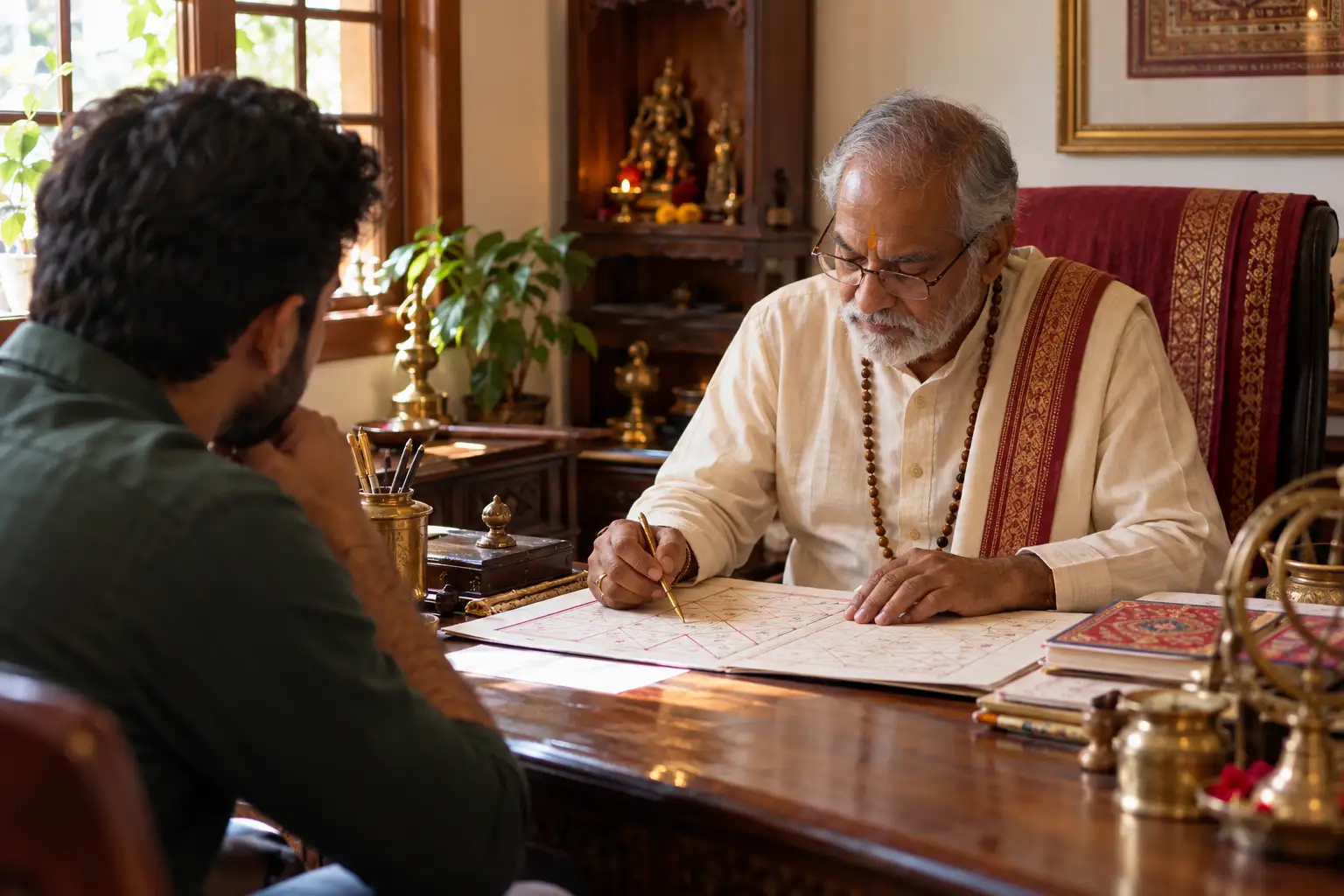
Normally an astrologer takes a birth time and predicts events. Rectification takes events that have already happened and works backwards to find the birth time that produces them. Your own life becomes the test.
The process runs roughly like this. A candidate window is established from whatever information exists. Within that window, the possible ascendants and their divisional variations are identified. Each candidate is then tested against your actual history — the year you married, when a career change happened, when you moved, when a significant loss or health event occurred. A birth time that produces a chart where those events fall in periods that support them is a candidate; one that does not is eliminated.
The more events you can date accurately, the tighter the result. Rectification with three events is far weaker than rectification with eight, and this is the single biggest factor in how precise a result you get.
Classical techniques are used alongside this — certain methods relate physical characteristics or the circumstances of birth to the ascendant — but event-based verification is what does most of the work in practice.

What You Need to Provide
The quality of the result depends almost entirely on the quality of what you bring, so this is worth preparing properly.
| Event Type | What Is Needed | Why It Helps |
|---|---|---|
| Marriage | Month and year | Strongly tied to the 7th house and Navamsa |
| Children born | Month and year for each | Tied to the 5th house and its periods |
| Career changes | Approximate dates of major shifts | Tied to the 10th house and D10 |
| Moving house or city | Year, and whether within India or abroad | Tied to 4th and 12th houses |
| Significant losses | Year of a parent or close family passing | Distinctive and well tied to specific periods |
| Major health events | Year of surgery or serious illness | Tied to 6th and 8th house periods |
| Education milestones | Year of graduation or a major exam result | Tied to 4th, 5th and 9th houses |
| Financial turning points | Year of a major gain or loss | Tied to 2nd and 11th house periods |
How Precise Can It Get?
This deserves an honest answer rather than an impressive one, because overclaiming here is common.
Where you have a reasonable window and a good number of well-dated events, rectification can usually narrow the time substantially — frequently to within a range of minutes, which is enough for the divisional charts to be reliable.
Where the starting window is wide — a whole day, or no information at all — and events are few or vaguely dated, the honest outcome may be a narrowed range rather than a single time. That is still valuable: reducing a full day to a two or three hour window makes a great deal of the chart usable.
And sometimes the honest answer is that it cannot be narrowed reliably. This happens, and it should be said. A practitioner who always produces a confident time to the minute regardless of what they were given is not doing the work; they are producing a number.
A useful marker: a good rectification comes with reasoning. You should be able to see which events tested well against the proposed time and which did not. If you receive a time with no explanation, you have no way to judge it, and neither does anyone else who reads your chart later.

When Family Members Remember Different Times
This is extremely common and easier to handle than people expect.
The useful approach is not to decide who is right but to treat every remembered time as a candidate and test them all. Frequently one aligns with life events clearly better than the others, which settles it without anyone having to be contradicted.
It also helps to ask what people actually remember rather than what time they state. Someone recalling that it was just after the morning tea, or that a particular relative had not yet arrived, or that it was still dark, gives you a usable anchor. Stated times are often reconstructed years later; remembered circumstances are frequently more reliable.
Hospital records, where they exist, are worth chasing. Older records in India are inconsistent, but where a birth certificate or hospital note records a time, it is a stronger starting point than family memory — though not infallible, since recorded times were sometimes entered later or rounded.
Where memories conflict irreconcilably, the range they span becomes the starting window and rectification proceeds from there. Conflicting accounts are a starting point, not an obstacle.
If You Have No Birth Time At All
This is workable, though the process is longer and the result is usually a range rather than a precise time.
What helps most is any narrowing at all. Day or night is a substantial reduction. Morning, afternoon or evening narrows it further. A relative recalling a meal, a shift change, a train, or who was present can reduce a twenty-four hour window considerably before any astrology begins.
From there the process is the same, simply applied across a wider set of candidates and requiring more events to discriminate between them.
The honest expectation for a no-time case is a narrowed window rather than a single minute, and a chart that is reliable for broad reading and Dasha timing while remaining less certain for the finer divisional work. That is a real and useful outcome, and it is considerably better than reading a chart built on a guessed time as though it were accurate.
Some people arrive expecting that no time means no astrology is possible. That is not the case, and the Moon-based techniques in particular remain workable, since the Moon moves relatively slowly.

When Rectification Is Worth Doing
It is not needed by everyone, and saying so is more useful than recommending it universally.
Worth doing before a major reading you intend to act on, before a marriage match where the Navamsa matters greatly, before a career reading that depends on the D10, where past readings have consistently not fitted, and where you have been given conflicting ascendants by different astrologers.
Not particularly needed if you have a recorded time from a reliable source, if you want only a broad Moon-sign level reading, or if you are asking a question that does not depend on the finer chart divisions.
The sensible sequence: if your time is recorded and reliable, proceed. If it is approximate and you are about to commission something significant, rectify first — it is a smaller cost than a detailed reading built on a wrong foundation, and it only needs doing once.
That last point is worth emphasising. Rectification is a one-time exercise. Once your time is established with reasoning behind it, every future reading, match and remedy rests on solid ground.
Preparing Your Event List Properly
Since the quality of the result depends almost entirely on this, it is worth doing carefully rather than assembling it hurriedly during the session.
Work chronologically through your life rather than trying to recall events by importance. Starting from childhood and moving forward tends to surface things that would otherwise be forgotten — a family move at seven, a school changed at eleven, an illness at fifteen.
Month and year is usually enough. Exact dates are better where you have them, but do not omit an event because you cannot recall the day. A month is workable; a year alone is weaker but still usable.
Include events that felt significant even if they seem small. A job you did not get that changed your direction, a relationship that ended, a decision to move cities. These often discriminate between candidate times as well as the obvious milestones do.
Mark which dates you are confident about. This matters more than people expect. A rectification weighted on a date you are actually unsure of will drift. Saying clearly that a marriage date is certain and a career change is approximate lets the work be weighted properly.
Check documents where you can. Old certificates, passports, employment letters, property papers and photographs with dates frequently settle a year you had wrong by two or three. Family photographs are particularly useful for the earlier events.
Twenty minutes spent on this before a session changes the result substantially, and it is the one part of the process that is entirely in your hands.
What Happens After Your Time Is Established
It is worth knowing what changes, because people sometimes rectify and then do not use it properly.
Record it with the reasoning. Keep the rectified time and the note of which events supported it together, somewhere you will find it. Any astrologer you consult in future can then see how it was arrived at rather than taking it on trust or quietly using something else.
Use it consistently. The most common waste is having a time rectified and then continuing to give the old approximate time to other practitioners out of habit. Update it everywhere you have given birth details.
Expect the readings to change. If the rectified time shifted the ascendant, your chart is genuinely different from the one you were reading before. Previous interpretations that never fitted will make more sense in their absence, and it is worth revisiting any major reading you acted on.
Family charts may need the same treatment. Where one family member had an uncertain time, others born in the same period often do too, and the same records and memories that helped yours will help theirs.
One honest caveat: where the result was a narrowed range rather than a single time, keep treating it as a range. Using the midpoint as though it were established fact reintroduces exactly the false precision the process was meant to remove.
Common Mistakes People Make
Most of these come from underestimating how much the time affects.
Myths Worth Clearing Up
This is a technical subject and the misunderstandings around it are correspondingly practical.
| Common Belief / Myth | Practical Reality |
|---|---|
| A rough birth time is close enough. | The ascendant changes every two hours and the Navamsa roughly every thirteen minutes. A rough time can produce a chart that is right about your nature and wrong about everything specific. |
| Without a birth time, astrology is impossible. | A great deal remains workable, particularly Moon-based techniques, and rectification can usually narrow an unknown time to a usable window. |
| Rectification is guesswork. | It is systematic verification against events that have already happened. Candidate times are tested against your actual history and eliminated where they do not fit. |
| A good astrologer can find the time from your face or palm alone. | Classical techniques relating appearance to ascendant exist and are used as supporting input, but event-based verification does the substantive work. |
| Any rectified time can be given to the minute. | Precision depends on the starting window and the number of well-dated events. Sometimes the honest result is a narrowed range, and that should be said rather than a false precision offered. |
| You need to redo it periodically. | It is a one-time exercise. Once established with reasoning behind it, every future reading rests on it. |
How the Process Works
Longer than most consultations, because it is genuinely technical work.
- Share What You Have
Whatever time information exists, however vague, plus place of birth and date. Any hospital or certificate record.
- Narrow the Starting Window
Family recollections, circumstances remembered rather than times stated, and any documentary record.
- Prepare Your Event List
Dated life events — marriage, children, career changes, moves, losses, health episodes, education milestones.
- Identify Candidate Times
The possible ascendants and divisional variations within the window are established.
- Test Against Your History
Each candidate is checked against whether your events fall in periods that support them.
- Narrow and Confirm
Candidates are eliminated until a time or a workable range remains, with the reasoning recorded.
- You Receive the Reasoning
Not just a time, but which events supported it — so you and any future astrologer can judge it.
Rectification Across Greater Noida, Delhi NCR and Worldwide
This service works particularly well remotely, since it depends entirely on information you provide rather than on presence. Video-call sessions are conducted across India and worldwide, and it is a frequent request from people born abroad, or from NRI families where records are incomplete or in an unfamiliar format. In-person sessions are available across Greater Noida, Noida, Ghaziabad and the wider Delhi NCR region. Sessions are conducted in Hindi or English.
Who This Is For, and Who Does Not Need It
It genuinely helps anyone with no recorded birth time, people whose time is approximate or rounded, families where members remember different times, anyone whose readings have never quite fitted, and people given conflicting ascendants by different astrologers.
Who does not need it: if you have a reliable recorded time from a hospital record or certificate, proceed with your reading directly. If you want only a broad Moon-sign level view, the finer precision is not required. And if you are about to commission a detailed reading and your time is uncertain, do this first rather than after — it is the smaller cost and everything else depends on it.
Frequently Asked Questions
The ascendant changes roughly every two hours, and changing it moves every planet into a different house. The Navamsa changes roughly every thirteen minutes and the Dashamsha faster still, which is why marriage and career readings suffer most from an approximate time.
It is the reverse of ordinary astrology. Instead of taking a time and predicting events, it takes events that have already happened and works backwards to find the birth time that produces them. Your own life history becomes the test.
Dated life events — marriage, children, major career changes, moves, significant losses, health episodes, education milestones. Month and year is usually enough. The more events you can date, the tighter the result.
More is substantially better. Three events cannot discriminate between candidate times the way eight can. This is the single biggest factor in how precise a result you get, so preparing a proper list before the session is worth the effort.
With a reasonable starting window and well-dated events, often within a range of minutes — enough for the divisional charts to be reliable. With a wide window and few events, the honest outcome may be a narrowed range rather than a single time.
Yes, though the process is longer and the result is usually a range. Any narrowing helps enormously — day or night, morning or evening, or a relative recalling a meal or who was present, reduces the window considerably before any astrology begins.
Treat every remembered time as a candidate and test them all. Frequently one aligns with life events clearly better, which settles it without anyone having to be contradicted. Conflicting accounts are a starting point, not an obstacle.
It is a stronger starting point than family memory and worth chasing. Not infallible though — recorded times were sometimes entered later or rounded — so it is treated as a strong candidate rather than settled fact.
Classical techniques relating physical characteristics to the ascendant exist and are used as supporting input. But event-based verification does the substantive work, and anyone claiming to determine a time from appearance alone is overstating what that method can do.
You should receive the reasoning, not just a number — which events tested well against the proposed time and which did not. Without that you cannot judge the result, and nor can any astrologer who reads your chart later.
No, it is a one-time exercise. Once your time is established with reasoning behind it, every future reading, match and remedy rests on solid ground. That is what makes it worth doing properly.
Before any major reading you intend to act on, before a marriage match where the Navamsa matters, and before a career reading depending on the D10. It is a smaller cost than a detailed reading built on a wrong foundation.
It is the most common explanation, and more common than an astrologer being wrong. An approximate time produces a chart that can be right about your general nature and wrong about everything specific — which is exactly the experience people describe.
It works particularly well remotely, since it depends entirely on information you provide rather than on presence. It is a frequent request from people born abroad or from NRI families where records are incomplete or in an unfamiliar format.
Ready to Talk This Through?
Whether you are buying a new property, renovating, or simply want a second, honest opinion — Kkomal provides accurate, no-demolition guidance tailored to your unique layout and situation, in person across Greater Noida & Delhi NCR, and online for the rest of India and abroad.
📞 +91 99531 11782 | ✉ kkomalvasisht@gmail.com
Business Astrology — Partnership, Timing and Knowing When to Push Career Astrology Consultation — Direction, Timing & Honest Guidance Education Astrology — Stream, Exams and Study Abroad Health Astrology — Supportive Wellbeing Insight, Alongside Your Doctor Lagna / Ascendant Kundli / Birth Chart Nakshatra Finder Vimshottari Dasha