Vastu for Flats and Apartments (1, 2 & 3 BHK)
Most Vastu advice was written for independent houses on their own plots, and most people in Delhi NCR live in flats.
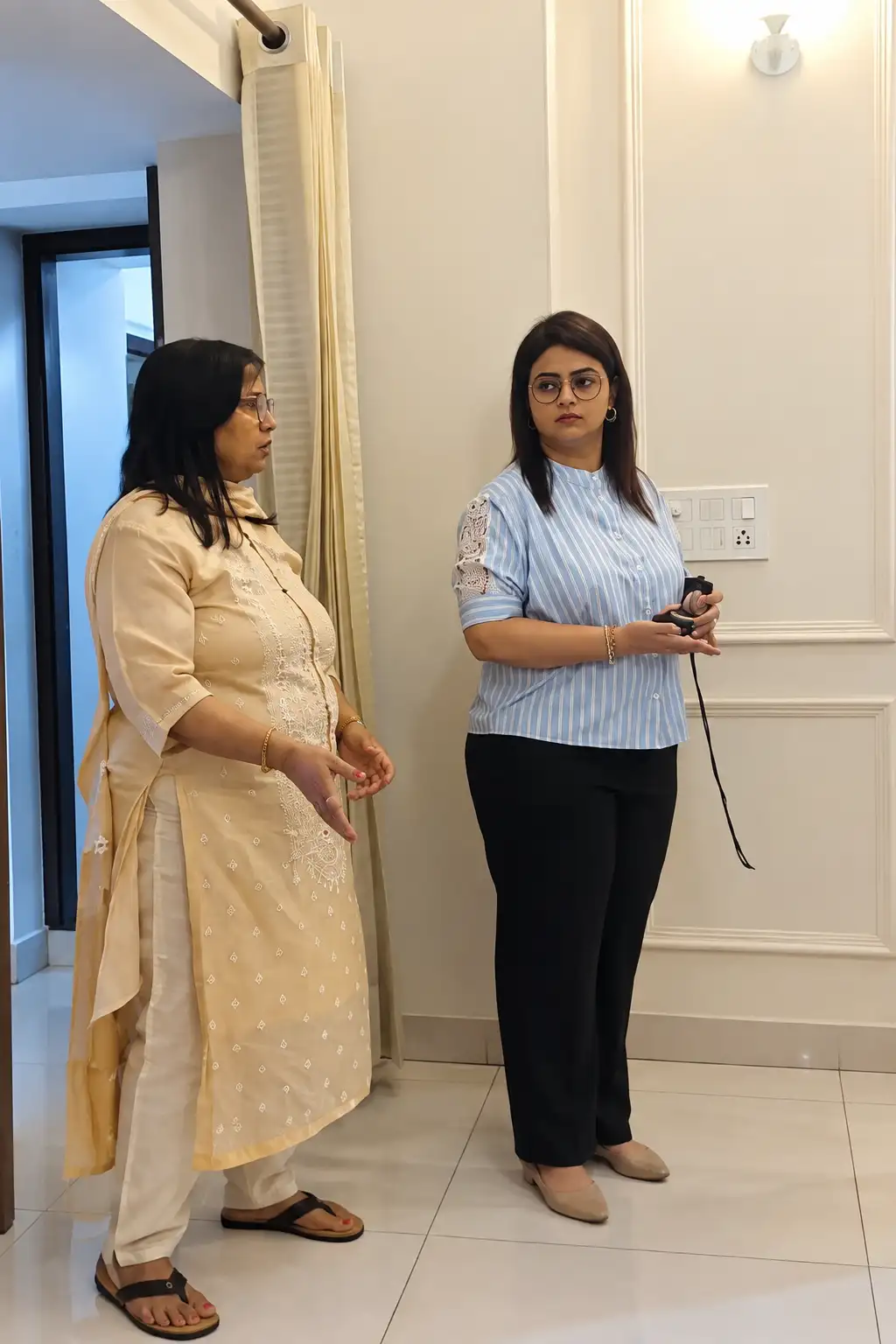
Most Vastu advice was written for independent houses on their own plots, and most people in Delhi NCR live in flats. That mismatch is why so much of what you read feels either impossible to follow or vaguely alarming. You cannot move a wall, relocate a bathroom, change the direction the building faces, or do anything about where the lift and staircase sit. Vastu guidance for flats with Kkomal Vasisht, an IAF-certified Vastu consultant with 15+ years of practice and 15,000+ clients guided, starts from that reality. It separates what genuinely matters and can be changed — your own main door, how each room is used, where things are placed, sleeping direction, colour and light — from what cannot be changed and therefore should not be worried about. Consultations are held in person across Greater Noida and Delhi NCR, and online by video call for clients anywhere else in India or abroad.
What You’ll Learn
- Flat facing: what to check, and what it actually changes
- Related Vastu guides and free tools
- Does Vastu Even Apply to a Flat?
- What You Cannot Change, and Can Stop Worrying About
- What Actually Matters in a Flat
- Your Flat Main Door
- Room by Room in a Flat
- Small Flats — 1BHK and Studio
- 2BHK and 3BHK Flats
- Builder Floors and Independent Floors
- Before You Buy a Flat — What to Actually Check
- The Honest Limits of Vastu When Buying
- Corrections That Work in Any Flat
- Rented Flats
- Common Mistakes Flat Owners Make
- Myths Worth Clearing Up
- How the Assessment Works
- Flat Vastu Across Greater Noida, Delhi NCR and Worldwide
- Who This Is For, and Who Needs Something Else
- FAQs
- Get Your Consultation
At a Glance
- Vastu applies to a flat: each flat is treated as its own independent unit, assessed from its own centre and its own main door.
- The building entrance, lift, staircase and common areas are not yours to change and are not what your assessment turns on.
- What matters and can be worked with: your flat main door, room usage and allocation, placement, sleeping direction, colour and light.
- Every correction is non-structural — nothing needs breaking, and nothing needs society or landlord permission.
- Before buying, the flat main door direction, the shape of the built-up area and the position of the kitchen and master bedroom are the checks worth making.
- A flat with some defects is normal. The question is which defects matter for you and which are best left alone.
Are You Facing These Problems?
- Every Vastu article you read assumes an independent house with a plot.
- You have been told your flat has a defect but cannot change anything structural about it.
- You are buying a flat and want to know what to check before signing.
- Your building entrance faces a direction someone told you is bad, and you cannot do anything about it.
- You live in a 1BHK or 2BHK where one room has to serve several purposes.
- You rent, so nothing permanent can be altered.
- You want to know what genuinely matters and what you can safely stop worrying about.
Flat facing: what to check, and what it actually changes
| Flat faces | Main door is ideally in | Watch for | What it changes in practice |
|---|---|---|---|
| East | East or north-east of the east wall | A toilet opening straight at the door | Morning light into the living area; the easiest facing to work with |
| North | North or north-east of the north wall | Heavy storage in the north-east | Even light all day, no harsh sun; usually the quietest |
| West | North-west or west of the west wall | Afternoon heat through large west glazing | Hot evenings unless shaded; blinds matter more than any rule |
| South | South-east of the south wall | A door in the exact south-west corner | Traditionally least liked, and the one where a careful layout matters most |
| Corner flat | Whichever side the lift lobby is not on | Cross-draught lost to a blocked window | Two outside walls means more light and more heat; both have to be managed |

Related Vastu guides and free tools
Does Vastu Even Apply to a Flat?
This question comes up constantly and deserves a direct answer, because classical Vastu texts describe plots and independent houses — apartments did not exist when they were written.
The traditional reasoning practitioners use is straightforward. A plot of land is treated as a Vastu unit. When that plot is divided, each portion becomes its own unit. By the same logic, when a floor of a building is divided into flats, each flat is treated as an independent Vastu unit with its own centre, its own directions and its own main door. The comparison usually offered is a magnet: break it and each piece becomes a complete magnet in itself.
What follows from this is the most useful principle on the page. Your assessment is built from your flat — its centre, its door, its rooms — not from the building. The tower can be a hundred flats, and yours is still read on its own terms.
What You Cannot Change, and Can Stop Worrying About
This section exists because a great deal of anxiety in flat owners is spent on things that were never theirs to control.
The building main entrance, the position of the lift and staircase, the shape and orientation of the tower, the location of the water tank, the common corridor, the parking, the direction the block faces — none of these are your Vastu unit, and none of them can be altered by you.
Some practitioners will point at these and offer expensive remedies. Be sceptical of that. If a factor is shared by four hundred families in a society, it is not the explanation for what is happening in your particular home. Your flat main door, your rooms, your placement and your usage are what your assessment turns on — and, usefully, those are exactly the things you can act on.
There is one honest exception. If you are still choosing a flat, some of these become relevant as selection criteria, because at that stage you can pick a different unit. Once you have moved in, they belong on the leave-alone list.

What Actually Matters in a Flat
These are the factors an assessment focuses on, in rough order of importance.
| Factor | Why It Matters | Can You Change It? |
|---|---|---|
| Your flat main door | The primary entry point of your unit | Not the position, but the treatment and usage |
| Room allocation | Which room serves which purpose | Yes, fully |
| Sleeping direction | Rest and personal alignment | Yes, today, at no cost |
| Kitchen zone and stove facing | The fire element of the home | Facing yes, position rarely |
| North-east condition | Clarity zone, most common defect | Yes — clear it and light it |
| South-west weight | Stability zone | Yes — place heavy furniture |
| Placement and storage | Where weight and clutter sit | Yes, fully |
| Colour and light | Elemental balance in each zone | Yes, at low cost |
| Building entrance, lift, tower shape | Shared, not your unit | No — leave it alone |
Your Flat Main Door
The main door of your flat is the single most discussed element, so it is worth being clear about what can and cannot be done.
You cannot change its direction — the builder decided that. What you can do is treat it properly, and this matters more than most people expect. Keep the entrance area genuinely clean and free of shoes, bags and stacked deliveries, which is where most flat entrances quietly fail. Ensure it is well lit; a dim landing outside and a dark entry inside is common in apartments and easy to correct with a light. Make sure the door opens fully inward without obstruction and does not creak. A small threshold marker, a nameplate kept clean, and a plant near the entry where the corridor allows are traditional and harmless.
What is generally avoided directly facing the main door: a mirror, a bathroom door, and the kitchen. Where the layout puts one of these in line, the correction is usually a screen, a curtain, keeping the offending door closed, or simply repositioning a mirror — all non-structural.
If the door direction is one you have been told is unfavourable, the honest position is this: it is one factor among many, the flat is assessed as a whole, and there is no version of this where breaking the entrance is a reasonable recommendation.

Room by Room in a Flat
The general principles hold, but the practical advice differs when you cannot move anything.
Master Bedroom
The south-west is the traditional placement, and in many flats one bedroom does fall in that zone. Where it does, allocate it to the head of the household. Where it does not, the correction is not to break anything but to give the south-west of the flat weight through heavy furniture or storage, and to focus on sleeping direction within whichever room is used. Head toward the south is the general principle, with east also considered good.
Kitchen
The south-east is ideal and builders frequently place kitchens elsewhere. Relocating a kitchen in a flat is almost never practical, and it is rarely recommended. The workable corrections are the direction faced while cooking, keeping the stove and the water source from sitting directly adjacent, appropriate colour in the zone, and keeping the kitchen clean and well ventilated. This captures most of the benefit without touching plumbing or gas lines.
Bathrooms
A bathroom in the north-east is the most common complaint in flats and almost never worth relocating. The standard approach is keeping the door closed, correctional colour, a sea salt bowl replaced regularly, checking for any leakage or damp, and good ventilation. A leaking or damp bathroom matters more in practice than its direction, and it is the thing most worth fixing.
Puja Area
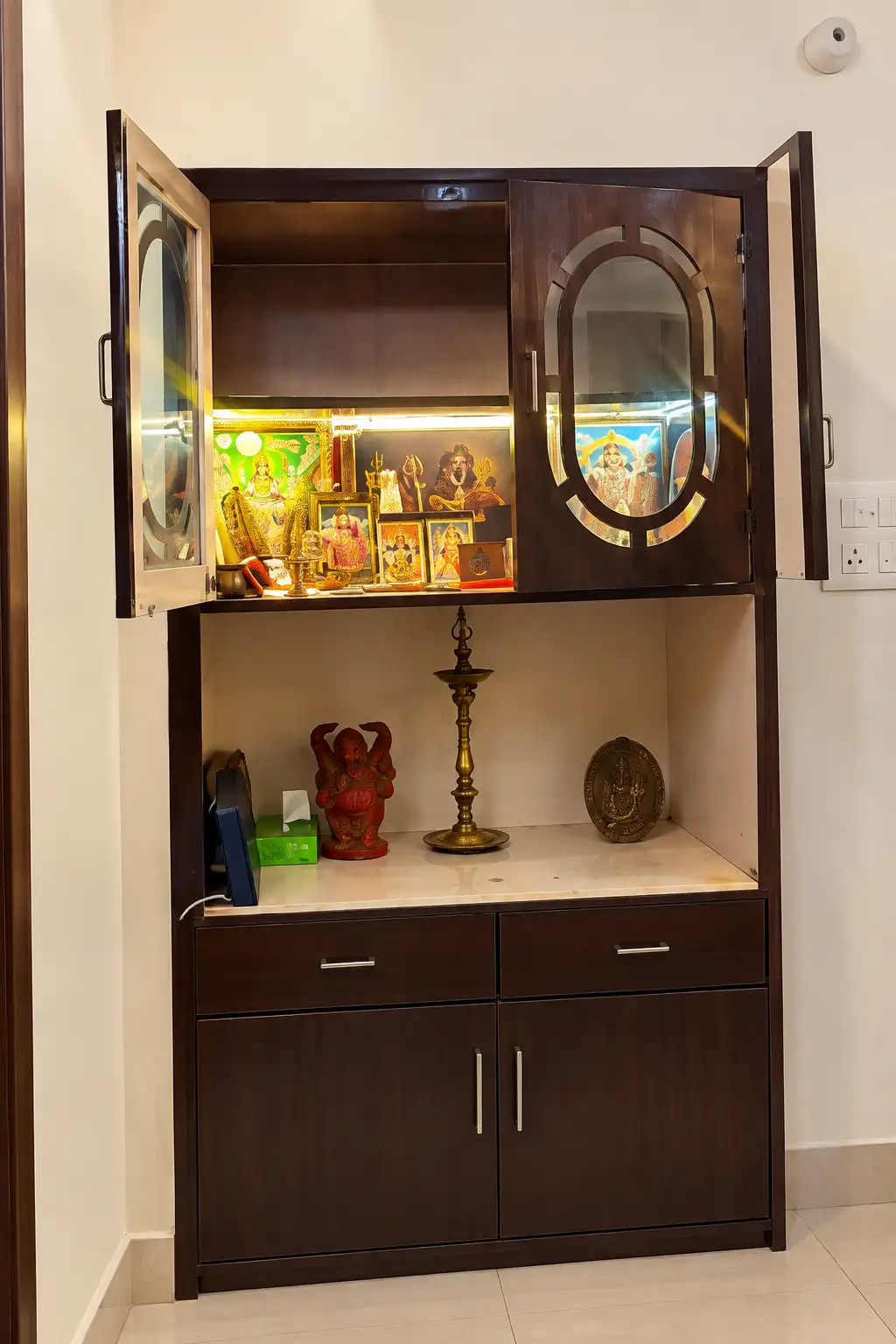
The north-east is the traditional place, and in a flat this often means a shelf or a small cabinet rather than a room. That is entirely acceptable. What matters is that it is clean, at a reasonable height, not adjoining a bathroom wall, and not tucked into a dark corner. A well-kept small shelf serves better than an elaborate setup that becomes cluttered.
Balcony and Windows
Balconies in the north or east are traditionally favoured, and where yours falls elsewhere the correction is about usage: keep it clean, avoid turning it into a storage dump, and let light and air in. In flats, balconies are the most common casualty of clutter, and clearing one often changes how the whole home feels.
Small Flats — 1BHK and Studio
When one room serves several purposes, standard advice stops being usable and needs adapting.
The practical approach is zoning rather than rooms. Even in a single room, the space has a north-east, a south-west and everything between. Sleep in the part of the room that falls toward the south or west, with the head toward the south. Put the heaviest furniture — the wardrobe, storage boxes — toward the south-west. Keep the north-east portion of the room clear, light and free of storage, which is difficult in a small flat and worth the effort anyway. Work or study facing east or north where you can.
The most valuable correction in a small flat is almost always decluttering, and it is free. A 1BHK carries the same possessions as a larger home in a fraction of the space, and the north-east corner is usually the first place that fills up. Clearing it consistently produces the most noticeable change residents report.
One honest note: in a very small flat, several principles will conflict because there is simply not enough room to satisfy all of them. A good assessment tells you which two or three to prioritise and explicitly releases you from the rest.
2BHK and 3BHK Flats
With more rooms, allocation becomes the main lever, and it costs nothing.
In a 2BHK, the decision is usually which bedroom the couple takes and which becomes the child or guest room. The bedroom falling toward the south-west is the traditional choice for the head of the household; the other typically works for children or guests. Where neither falls cleanly in the south-west, the choice is made on the next best zone and on sleeping direction within each room.
In a 3BHK there is more flexibility, and this is where a personalised assessment adds most value — different family members may suit different rooms based on their own charts, which is covered in the Astro-Vastu home analysis. The general placement holds: master bedroom toward the south-west, children toward the west or south, guests toward the north-west, and the north-east kept for the puja area and light rather than as a bedroom.
A recurring finding in 3BHKs worth naming: the spare bedroom in the north-east quietly becomes the store room. It is convenient, nobody sees it, and it is the single most common defect created by residents rather than builders.
Builder Floors and Independent Floors
Common across Delhi NCR and slightly different from a high-rise flat.
A builder floor usually occupies a whole floor of a small building, which means you have the full footprint of the plot rather than a portion of a large floor plate. This is generally an advantage — the shape is usually a clean rectangle, the directions are easier to establish, and you often have your own entrance and sometimes a terrace.
What to check is the entrance to your floor, the internal staircase position where there is one, and whether the north-east has been given to a bathroom or store. Terraces and open areas above are usually a positive, provided they are kept clean rather than becoming storage. The assessment method is otherwise identical to a flat: your floor is your unit.
Before You Buy a Flat — What to Actually Check
This is where Vastu is genuinely most useful, because at the buying stage you still have choices. Once you have possession, most of it becomes a leave-alone list.
- Take a Compass Reading Inside the Flat
Stand at the centre of the built-up area facing the flat main door. Note the actual degrees, away from steel and phones.
- Check the Shape of the Built-Up Area
A clean square or rectangle is preferred. Note any cut corners, particularly in the north-east or south-west.
- Locate the North-East
See what occupies it. A bathroom or a heavy structural block there is a genuine consideration; a bedroom or living area is fine.
- Check the South-West
Ideally solid and enclosed. A balcony or a large opening in the south-west is worth noting.
- Note the Kitchen and Master Bedroom Zones
South-east kitchen and south-west master bedroom are ideal; note where they actually fall.
- Assess Light and Ventilation
Practical and Vastu-relevant at once. A dark flat with poor cross-ventilation is a real problem, whatever the directions say.
- Compare Two Options if You Have Them
Where you are choosing between units, these checks are far more useful as a comparison than as a pass or fail on one.
The Honest Limits of Vastu When Buying
A caution that belongs here rather than in the small print, because people make expensive decisions on this.
Location, budget, builder reputation, legal clearance, construction quality, carpet area and commute should drive a property decision. Vastu is a useful additional input and a good tiebreaker between two units you are genuinely happy with otherwise. It is not a reason to pay significantly more, to buy in a worse location, or to reject an otherwise excellent flat over a single directional finding.
Anyone using Vastu to push you toward or away from a purchase — particularly anyone connected to the sale — is misusing it. A responsible assessment tells you what the findings are and what can be corrected afterwards, so you can decide with full information rather than with anxiety.
Corrections That Work in Any Flat
Everything here is non-structural, reversible and needs nobody permission.
| Correction | Addresses | Cost and Effort |
|---|---|---|
| Clear the north-east | The most common flat defect | Free, a few hours |
| Change sleeping direction | Rest and alignment | Free, today |
| Reallocate bedrooms | Person-to-zone mismatch | Free, one weekend |
| Add weight to the south-west | Instability | Low, one afternoon |
| Light the entrance | Dim entry, common in flats | Low |
| Colour through furnishings | Elemental imbalance | Low, renter-friendly |
| Keep bathroom doors closed | North-east or misplaced bathroom | Free, a habit |
| Fix leaks and damp | Practical and Vastu-relevant | Varies, worth doing |
| Clear the balcony | Blocked light and air | Free |
Rented Flats
Every correction above works in a rental. Nothing needs drilling, breaking or landlord approval, and every one of them moves with you when you shift.
The two things worth adding for tenants. First, a new rental benefits from a genuine deep clean rather than a wipe-down — you know nothing about how the space was kept before you, and cleaning is treated as the base remedy in Vastu for exactly that reason. Second, if a rented flat has a genuinely structural problem, the honest answer is that it stays, and knowing this before you renew a lease is itself useful information.
Tenants sometimes assume Vastu is not for them because they cannot change anything permanent. In practice, the corrections that matter most in flats — clearing, allocation, sleeping direction, light and colour — are precisely the ones that need no permanence at all.
Common Mistakes Flat Owners Make
Most of these come from applying independent-house advice to an apartment.
Myths Worth Clearing Up
Flat-specific myths cause a lot of avoidable worry.
| Common Belief / Myth | Practical Reality |
|---|---|
| Vastu does not apply to flats at all. | Each flat is treated as its own independent unit with its own centre and door, in the same way a divided plot becomes separate units. |
| The building entrance direction decides your flat Vastu. | Your flat is assessed from its own door and centre. A shared building entrance is not your unit and not the explanation for your situation. |
| A south or west facing flat is unlucky. | Every direction has its own strengths and considerations. A well-planned south-facing flat is not inferior, and this belief mostly affects resale price rather than living. |
| You must break and rebuild to fix flat Vastu. | Almost nothing in a flat is worth structural correction. Clearing, allocation, direction, placement, colour and light do the real work. |
| A flat with any defect will bring trouble. | Every flat has findings. The useful question is which few matter for the people living there, and which should be deliberately ignored. |
| Vastu should decide which flat you buy. | Location, budget, quality and legal clearance should decide. Vastu is a tiebreaker between comparable options, not the deciding factor. |
How the Assessment Works
The process is the same whether in person or online; only delivery changes.
- Share the Flat Layout
A builder plan or a neat sketch of your flat with rough measurements, showing the main door.
- Compass Reading
Taken at the centre of your flat facing your main door, away from steel furniture and devices.
- Photographs
Entrance, each room, kitchen, bathrooms, balcony and any corner that feels heavy or unused.
- Zone Mapping
The eight directions are established within your flat and assessed as they actually are.
- Separate Fixable From Fixed
Findings are sorted into what you can act on and what belongs on the leave-alone list.
- Prioritised Corrections
An ordered plan, free items first, adapted to whether you own or rent.
Flat Vastu Across Greater Noida, Delhi NCR and Worldwide
In-person visits are easiest across Greater Noida, Noida, Ghaziabad and the wider Delhi NCR region, where most residents live in flats and builder floors and the space can be walked and read directly. For anyone elsewhere in India or abroad, the same assessment is delivered over a video call — you share a layout and compass reading, walk the flat on camera, and receive the same prioritised plan. Sessions are conducted in Hindi or English.
Who This Is For, and Who Needs Something Else
It genuinely helps flat and builder-floor residents who find standard Vastu advice unusable, buyers comparing units, people told about a defect they cannot change, tenants needing entirely reversible corrections, and anyone in a small flat where principles conflict.
Who needs something else: if you live in an independent house on your own plot, the home Vastu consultation covers plot-level factors this page deliberately sets aside. If you want room allocation matched to each family member birth chart, the Astro-Vastu home analysis is the right service. And if you are buying land or planning construction, plot and pre-construction guidance applies rather than this.
Frequently Asked Questions
Yes. Each flat is treated as its own independent Vastu unit with its own centre, directions and main door — in the same way a divided plot becomes separate units. Your assessment is built from your flat, not from the building.
It is not your Vastu unit and not what your assessment turns on. A factor shared by hundreds of families in a tower does not explain what is happening in your particular home. Be sceptical of anyone selling remedies for building-level factors.
Take a compass reading at the centre of the flat facing the main door, check the shape of the built-up area, see what occupies the north-east, check whether the south-west is solid, note where the kitchen and master bedroom fall, and assess light and ventilation.
No. Every direction has its own strengths and considerations, and a well-planned south-facing flat is not inferior. This belief affects resale pricing more than it affects living, and it should not make you reject an otherwise good home.
Relocation is almost never practical and rarely recommended. Keep the door closed, use correctional colour, place a sea salt bowl and replace it regularly, ensure good ventilation, and fix any leakage or damp — the damp matters more in practice than the direction.
Almost never worth it in a flat. The workable corrections are the direction faced while cooking, keeping the stove and water source from sitting directly adjacent, appropriate colour, and keeping the kitchen clean and ventilated.
Using the north-east as a store room, and it is created by residents rather than builders. It is convenient, nobody sees it, and it affects the clarity zone. Clearing and lighting it is free and often produces the most noticeable change.
Think in zones rather than rooms. Sleep toward the south or west part of the room with the head south, put heavy furniture toward the south-west, keep the north-east portion clear and light, and work facing east or north. Decluttering matters most and costs nothing.
The bedroom falling toward the south-west is the traditional choice for the head of the household, with the other used for children or guests. Where neither falls cleanly in the south-west, choose the next best zone and focus on sleeping direction within each room.
Slightly, and usually to your advantage. A builder floor typically occupies the full plot footprint, so the shape is cleaner, directions are easier to establish, and you often have your own entrance. The assessment method is the same — your floor is your unit.
Fully. Clearing, room allocation, sleeping direction, placement, colour and light need no drilling, no permission and no permanence, and they move with you. A genuine deep clean on moving in is also worth doing, since cleaning is the base remedy in Vastu.
Every flat has findings — that is normal, not a warning. The useful question is which two or three actually matter for the people living there, and which should be deliberately left alone. A good assessment tells you what to ignore as clearly as what to fix.
No. Location, budget, builder reputation, legal clearance, construction quality and commute should decide. Vastu is a useful tiebreaker between two units you are genuinely happy with otherwise — not a reason to pay more or buy in a worse location.
Yes, with no loss of depth. You share your flat layout and a compass reading taken at its centre, walk the rooms on camera, and receive the same prioritised plan. In-person visits are easiest across Greater Noida and Delhi NCR.
Cut corners and irregular shapes are common in modern layouts. They are noted, particularly in the north-east and south-west, and corrected non-structurally using mirrors, placement and symbolic correctors to visually complete the zone. No construction is involved.
Related Video

Ready to Talk This Through?
Whether you are buying a new property, renovating, or simply want a second, honest opinion — Kkomal provides accurate, no-demolition guidance tailored to your unique layout and situation, in person across Greater Noida & Delhi NCR, and online for the rest of India and abroad.
📞 +91 99531 11782 | ✉ kkomalvasisht@gmail.com
How to Remove Negative Energy from Home with Vastu Factory Vastu: Main Gate, Machinery & Storage Direction Home Vastu Consultant in Greater Noida & Online Across India Hospital and Clinic Vastu: Layout, Zones and Corrections Kundli / Birth Chart Lo Shu Grid