Which Pooja Should You Do and When — Vidhi, Samagri and Muhurat
Most people who ask about pooja are not asking a spiritual question.


Most people who ask about pooja are not asking a spiritual question. They are asking a practical one: something specific is going on — a new house, a persistent problem, a planetary period someone warned them about — and they want to know whether a ritual is called for, which one, when, and what it will realistically involve. Pooja guidance with Kkomal Vasisht, an award-winning Vedic astrologer with 15+ years of practice and 15,000+ charts analysed, answers exactly that. This is advisory work, not a booking desk: what the ritual is genuinely for, how the muhurat is fixed from your chart rather than a generic calendar, what samagri to prepare, what a fair cost looks like so you are not overcharged, and — said plainly where it applies — when no pooja is needed at all. Guidance is given online by video call across India and worldwide, and in person across Greater Noida and Delhi NCR.
What You’ll Learn
- The Poojas People Most Often Ask About
- Vastu Shanti — The Most Requested, and the Most Misunderstood
- Graha Shanti — Only Once You Know Which Graha
- Griha Pravesh — Order of Events on the Day
- How the Muhurat Should Actually Be Fixed
- The Samagri — What to Prepare
- What It Should Cost — Honest Numbers
- How Long a Pooja Takes
- What a Pooja Actually Does — and What It Does Not
- When You Honestly Do Not Need a Pooja
- The Sankalp — The Part That Carries the Weight
- Choosing a Pandit, and What to Ask Before Booking
- Preparing the House and the Family
- Common Mistakes Families Make
- Myths Worth Clearing Up
- Poojas Performed Remotely or Back Home
- Pooja Guidance Across Greater Noida, Delhi NCR and Worldwide
- FAQs
- Get Your Consultation
At a Glance
- The main poojas people ask about are Vastu Shanti (property and Vastu dosh), Graha Shanti (planetary affliction) and Griha Pravesh (entering a new home).
- A pooja is chosen from the actual situation and your chart — not performed as a general precaution because someone suggested it.
- The muhurat should be fixed against the family head birth nakshatra, not simply picked from a public panchang list.
- Most household poojas run one to three hours depending on scale; larger havan-based rituals take longer.
- Typical cost across NCR runs roughly Rs 5,000 to Rs 12,000 including pandit dakshina and samagri, varying with scale and city.
- A pooja supports a change you are also making yourself — it is not a transaction that guarantees an outcome.
Are You Facing These Problems?
- You are moving into a new home and do not know which pooja is required or in what order.
- Someone has told you to do a Graha Shanti but not which planet or why.
- You have been quoted a price for a pooja and cannot tell whether it is fair.
- You want to know what samagri to arrange so nothing is missing on the day.
- You were given a date from a general panchang and want it checked against your own chart.
- You suspect you are being sold a pooja you may not actually need.
- You live abroad or outside Delhi NCR and want guidance on a ritual being performed back home.
The Poojas People Most Often Ask About
Confusion usually starts because several rituals sound similar and are often bundled together by whoever is selling them. Here is what each one is actually for.

| Pooja | What It Addresses | Typically Done When |
|---|---|---|
| Vastu Shanti | Vastu dosh and the energy of the property itself | Before Griha Pravesh, after renovation, or during persistent trouble at home |
| Griha Pravesh | Entering and consecrating a new home | On first entry to a new or newly renovated house |
| Graha Shanti | A specific afflicted planet in the horoscope | During a difficult dasha, Sade Sati or a flagged dosha |
| Navagraha Shanti | All nine planets together | When no single planet is identified, or alongside other rituals |
| Satyanarayan Katha | General auspiciousness and gratitude | After a wish fulfilled, a new beginning, or on a full moon |
| Rudrabhishek | Devotional offering to Shiva | For health, protection, and through the month of Sawan |
| Dosh Nivaran | A named dosha such as Kaal Sarp or Manglik | Where the chart genuinely shows the dosha as active |
Vastu Shanti — The Most Requested, and the Most Misunderstood
Vastu Shanti addresses the property rather than the person. The ritual honours Vastu Purusha, the deity of the dwelling space, along with the deities of the eight directions and the five elements, and it is the traditional response where a home carries a structural Vastu defect that cannot practically be corrected by construction.
It is most commonly performed at three moments: before or alongside Griha Pravesh when moving into a new home, after significant renovation that has changed the structure, and where a family has been facing sustained difficulty at home and a Vastu review has identified defects.
The point worth understanding is that Vastu Shanti does not replace a Vastu correction. If the north-east is blocked or the kitchen sits in a difficult zone, the practical adjustments still matter. The pooja is the traditional accompaniment to those changes, not a substitute that lets you skip them.

Graha Shanti — Only Once You Know Which Graha
Graha Shanti addresses a planet that is afflicted or poorly placed in your horoscope, and everything about it depends on knowing which planet. That single detail is what separates a meaningful ritual from an expensive general-purpose one.
The sequence should therefore be: chart examined first, afflicted planet identified, ritual chosen for that planet, muhurat fixed for the person who will sit for it. Where someone recommends a Graha Shanti without ever having seen your chart, they are prescribing before diagnosing.
If nobody has identified a specific planet, the honest alternative is a Navagraha Shanti covering all nine together, which is the appropriate general form. It is also worth knowing that the mantra practice for the same planet costs nothing and can be done daily at home — for many people that is the sensible first step, with a formal pooja considered later if the situation calls for it.
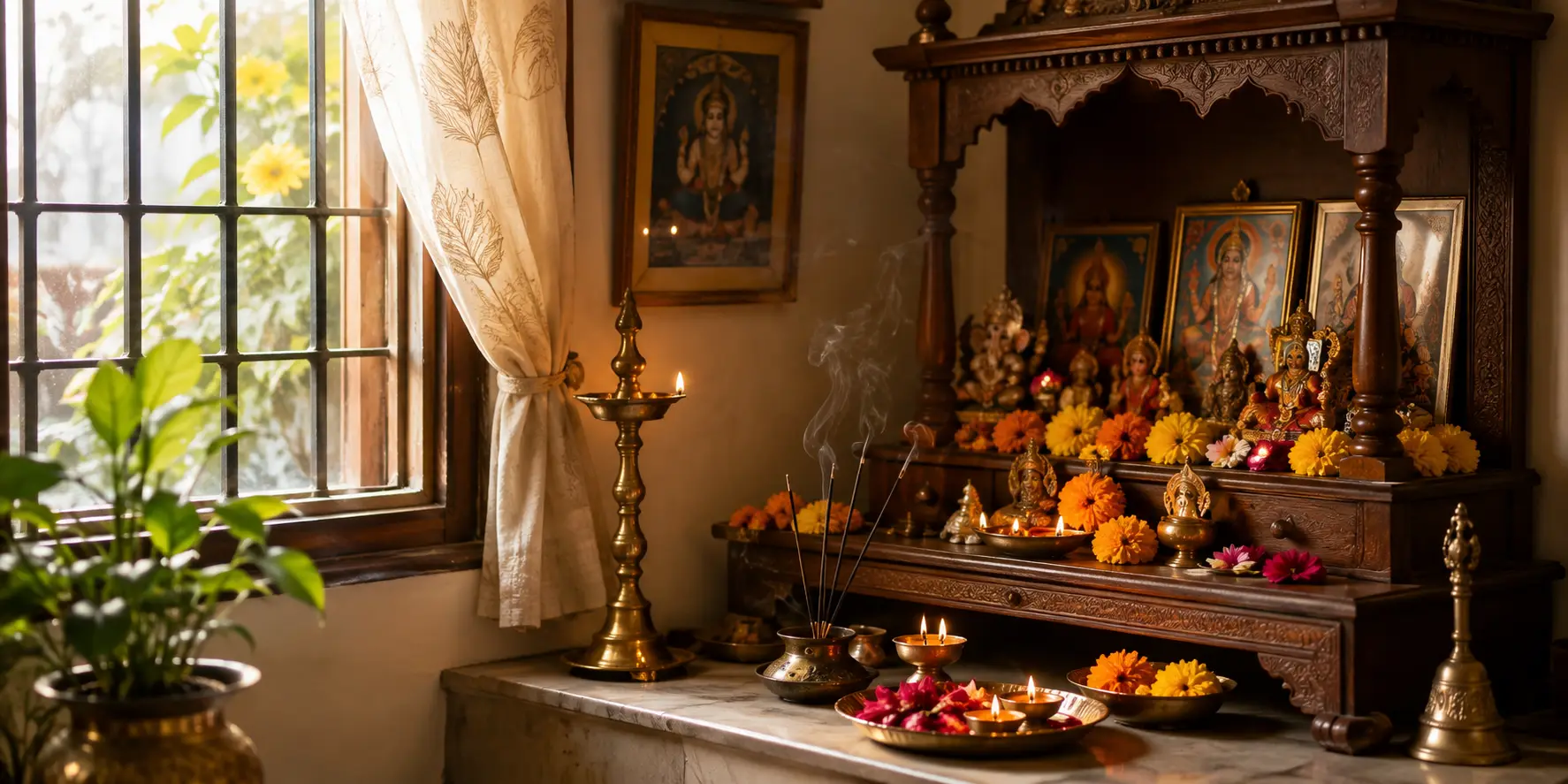
Griha Pravesh — Order of Events on the Day
Griha Pravesh causes the most last-minute confusion, largely because several rituals happen in sequence and families are unsure what comes first.
The usual order is: purification of the cleaned house with Gangajal, setting up the puja area with the kalash, mango leaves and coconut, invoking Ganesha to clear obstacles, the Vastu Shanti and Navagraha worship, the havan, and then the chulha pooja — the first lighting of the kitchen stove — followed by prasad and blessings.
One tradition worth respecting: the ceremony should ideally happen before the family sleeps in the house for the first time. Where people have already moved in and the muhurat keeps slipping, the ritual is still performed; nothing is ruined. But if the move is still ahead of you, arranging it beforehand is simpler.
Rented homes are frequently asked about. A full Griha Pravesh is not usually performed for a rental, but a simple purification and Vastu Shanti on entry is common and reasonable, particularly where you know nothing about the previous occupants.
How the Muhurat Should Actually Be Fixed
This is where most guidance quietly falls short. A public panchang gives dates that are auspicious in general — useful, but not personal. A muhurat fixed properly also weighs the birth nakshatra of the person who will sit for the ritual, usually the head of the household, along with the Tara Bala and Chandra Bala for that day, and avoids the daily inauspicious windows such as Rahu Kaal regardless of how good the rest of the day looks.
Certain periods are traditionally avoided for auspicious beginnings, including Shraadh (Pitru Paksha) and Adhik Maas. Within the year, the Uttarayan months are broadly considered favourable, and days such as Akshaya Tritiya, Vasant Panchami and Makar Sankranti are traditionally strong for new beginnings.
The practical advice is simple: choose the muhurat early. Auspicious windows for a specific month are limited, and late selection leaves you choosing from whatever remains rather than from what suits your family.
The Samagri — What to Prepare
Missing an item on the day causes real stress, and the list varies with the ritual. Below is the common core that most household poojas require, so you can prepare rather than scramble.
| Category | Items |
|---|---|
| Kalash setup | Copper or brass kalash, mango leaves, whole coconut, red thread |
| Offerings | Fresh flowers, fruit, sweets, betel leaves and nuts, dry fruits |
| Panchamrit | Milk, curd, honey, sugar, ghee |
| Marking and colour | Haldi, kumkum, chandan, abir, gulal, rangoli colours |
| Light and fragrance | Ghee and oil lamps, wicks, camphor, incense |
| Havan (if included) | Havan kund, mango wood, havan samagri, ghee, black sesame |
| Grains and water | Rice, navadhanya (nine grains), Gangajal, durva grass |
| Vessels | Thali, small bowls, spoon, cloth for the altar |
What It Should Cost — Honest Numbers
People are routinely overcharged here because they have no reference point, so it is worth stating plainly.
Across Delhi NCR, a standard household pooja such as Vastu Shanti or Graha Shanti with one pandit, including dakshina and samagri, commonly runs somewhere in the region of Rs 5,000 to Rs 9,000. Larger arrangements — multiple acharyas, more elaborate mandalas, extended mantra counts and a longer havan — can reasonably reach Rs 12,000 or more. Cost varies genuinely with the number of pandits, the amount of samagri, the duration, and the city.
What should raise a question is a quote far outside that range with no corresponding difference in scale, or a package that keeps expanding as the date approaches. A fair arrangement is agreed in advance: how many pandits, how long, what is included, who arranges the samagri. Ask that before booking, not after.
It is also entirely acceptable to arrange the samagri yourself and pay only dakshina and coordination. Many families do, and it usually costs less.
How Long a Pooja Takes
A short, simple household ritual typically runs about an hour to an hour and a half. A standard Graha Shanti or Vastu Shanti with a modest havan usually takes closer to two hours. Larger arrangements with multiple acharyas, extended mantra counts and a full havan can run two and a half to three hours or more.
Plan the day around that honestly. Families frequently schedule a pooja immediately before movers arrive or guests are due, and the resulting hurry undermines the calm the ritual is meant to establish. Leave room around it.
What a Pooja Actually Does — and What It Does Not
This section matters more than any samagri list. A pooja is a formal, focused act of intention performed within a tradition. It marks a beginning, acknowledges what is being asked for, and brings a household together around it. That is genuinely valuable, and it is why these rituals have persisted for so long.
What it is not is a transaction. Performing a Graha Shanti does not remove a planetary period; nothing removes a planetary period. Performing a Vastu Shanti does not correct a structural defect that still needs a practical adjustment. Performing a Griha Pravesh does not guarantee that everything in the new home will go well.
Any practitioner who frames a ritual as a guaranteed outcome — or worse, who suggests that misfortune will follow if you skip it — is working on fear rather than tradition. Pooja belongs alongside your own effort and practical action, supporting them rather than substituting for them.
When You Honestly Do Not Need a Pooja
This section rarely appears anywhere, which is exactly why it belongs here.
You do not need a pooja simply because you have moved house and someone mentioned it, if the property has no identified Vastu concern and you have no particular difficulty. You do not need a Graha Shanti because a stranger told you a planet is bad without ever seeing your chart. You do not need an expensive dosh nivaran ritual for a dosha that turns out, on examination, to be mild or cancelled in your chart — and a great many flagged doshas are exactly that.
Where a mantra practice or a simple household observance addresses the situation adequately, that is what should be recommended, because it costs nothing. An honest consultation is as willing to say no pooja is needed as it is to arrange one, and you should expect that from anyone advising you.
The Sankalp — The Part That Carries the Weight
Every pooja begins with a sankalp: the person sitting for the ritual states aloud who they are, where they are, and what they are asking for. Families often treat this as a procedural step handled by the pandit, and something is lost when they do.
The sankalp is what turns a set of actions into an intention. It is worth knowing beforehand what you are actually asking for and stating it with attention rather than repeating syllables while thinking about the guest list. If you understand nothing else about the vidhi, understand this part — it is the part that is yours rather than the pandit.
Choosing a Pandit, and What to Ask Before Booking
Almost no one talks about this, and it is where a good ritual becomes a rushed one. The person performing the pooja matters as much as the ritual itself, and a few questions asked beforehand save a great deal of disappointment.
Ask which specific pooja will be performed and roughly how long it will take, so you can plan the day honestly rather than discovering at noon that it runs another two hours. Ask whether the samagri is included or whether you are arranging it, and get the list either way. Ask how many pandits will attend, since that is the single biggest driver of cost. And ask whether the muhurat has been fixed against your own nakshatra or taken from a general calendar — the answer tells you a lot about how the rest will be handled.
One quiet signal worth noticing: a pandit who asks you what the situation is, and who is willing to say that a simpler ritual would do, is generally more trustworthy than one who agrees immediately to whatever you name. The willingness to recommend less is a reasonable proxy for honesty in this field.
Preparing the House and the Family
The practical preparation is straightforward, and doing it properly changes how the day feels.
The house should be genuinely cleaned beforehand, not tidied at the last minute — the cleaning is treated as part of the purification rather than a separate chore. The puja area is set up in a clean, undisturbed spot, traditionally in the north-east where that is available. Enough floor seating should be arranged for everyone participating, since people sit through most of the ritual.
The family itself is usually asked to bathe beforehand and wear clean, preferably traditional clothes. Leather items are traditionally set aside for the duration. Those who wish to may keep a light fast until the prasad, though this is a matter of personal practice rather than a requirement, and anyone whose health makes fasting unsuitable should simply not do it.
A small practical point that matters more than people expect: put phones away for the duration. A ritual is an act of attention, and a household half-watching notifications gets a proportionately smaller amount out of it.
Common Mistakes Families Make
Most of these are logistical or financial rather than ritual, which is where things actually go wrong.
Myths Worth Clearing Up
Ritual attracts both inflated promises and unnecessary anxiety.
| Common Belief / Myth | Practical Reality |
|---|---|
| A Graha Shanti removes a difficult planetary period. | Nothing removes a planetary period. The ritual is a focused act of intention that supports you through it, which is a genuine thing rather than a lesser one. |
| A Vastu Shanti means you can skip the Vastu correction. | The pooja accompanies practical adjustments rather than replacing them. A blocked north-east still needs clearing. |
| A bigger, costlier pooja works better. | Scale changes duration and elaborateness, not efficacy. A modest ritual performed with attention is not inferior to an expensive one. |
| Every dosha needs an expensive nivaran pooja. | Many flagged doshas turn out mild or cancelled on examination. Check whether it is genuinely active before paying for a ritual. |
| Skipping a pooja invites misfortune. | This is fear-based selling, not tradition. If a pooja is not warranted by the situation, not doing it carries no penalty. |
| The pandit handles everything, so the family need not understand it. | The sankalp is yours. Knowing what you are asking for is the part that makes the ritual meaningful rather than mechanical. |
Poojas Performed Remotely or Back Home
A common situation for families abroad: the ritual is to be performed at a property in India while the family is overseas, or the family wants to participate over a video call. Both are workable, and neither is treated as inferior.
What matters practically is that the sankalp names the right person and place, that the muhurat is calculated for the location where the ritual is being performed rather than where you are sitting, and that someone trustworthy is present to arrange the samagri. Guidance here usually focuses on getting those three things right and on confirming the muhurat against the family head chart before the date is fixed.
Pooja Guidance Across Greater Noida, Delhi NCR and Worldwide
In-person guidance is easiest to arrange across Greater Noida, Noida, Ghaziabad and the wider Delhi NCR region. For anyone elsewhere in India or abroad, video-call sessions serve equally well, since this work is fundamentally about examining the chart, fixing the muhurat correctly, preparing you for what the day involves and giving an honest view of what is actually needed. Sessions are conducted in Hindi or English.
Frequently Asked Questions
It depends on the situation rather than a general rule. Vastu Shanti addresses the property and Vastu dosh, Graha Shanti addresses a specific afflicted planet in the horoscope, and Griha Pravesh is for entering a new home. If nobody has identified a specific planet, a Navagraha Shanti covering all nine is the appropriate general form.
It honours Vastu Purusha, the deity of the dwelling space, along with the deities of the eight directions and the five elements. It is performed before Griha Pravesh, after significant renovation, or where a family has faced sustained difficulty and a Vastu review has identified defects.
No. If the north-east is blocked or the kitchen sits in a difficult zone, the practical adjustments still matter. The pooja is the traditional accompaniment to those changes, not a substitute that lets you skip them.
Properly, it weighs the birth nakshatra of the person sitting for the ritual, along with Tara Bala and Chandra Bala for that day, and avoids daily inauspicious windows like Rahu Kaal. A public panchang gives dates auspicious in general, which is useful but not personal to your family.
The common core is a kalash with mango leaves and coconut, flowers, fruit, sweets, betel, panchamrit, haldi and kumkum, lamps and camphor, rice, navadhanya and Gangajal, plus havan items where a havan is included. Get the exact list a week ahead rather than the day before.
Across Delhi NCR, a standard household pooja with one pandit including dakshina and samagri commonly runs roughly Rs 5,000 to Rs 9,000, with larger arrangements reaching Rs 12,000 or more. Agree the scope in advance — how many pandits, how long, what is included — rather than after booking.
A simple household ritual runs about an hour to an hour and a half; a standard Graha Shanti or Vastu Shanti with a modest havan takes closer to two hours; larger arrangements can run two and a half to three hours or more. Leave clear time either side rather than squeezing it between other commitments.
Yes, and many families do. Paying only dakshina and coordination while arranging the items yourself usually costs less. Ask for the list well in advance so nothing is missing on the day.
A full Griha Pravesh is not usually performed for a rental, but a simple purification and Vastu Shanti on entry is common and reasonable — particularly where you know nothing about the previous occupants.
The ritual is still performed and nothing is ruined. Tradition prefers it before the family first sleeps in the house, so if your move is still ahead, arranging it beforehand is simpler. If not, it is done afterwards without any difficulty.
No. Nothing removes a planetary period, and anyone promising that is selling rather than teaching. The ritual is a focused act of intention that supports you through the period, which is worthwhile in itself.
Compare the quote against the typical NCR range and against the actual scale — number of pandits, duration, samagri included. A price far outside that range with no corresponding difference in scale, or a package that keeps expanding as the date nears, is worth questioning.
Often not. If the property has no identified Vastu concern and you face no particular difficulty, no pooja is required. Where a mantra practice or a simple household observance addresses the situation, that should be recommended instead, because it costs nothing.
It is the statement at the start where the person sitting for the ritual says who they are, where they are, and what they are asking for. It is what turns a set of actions into an intention, and it is the part that belongs to you rather than the pandit.
Yes, and it is not treated as inferior. What matters is that the sankalp names the right person and place, the muhurat is calculated for where the ritual is being performed rather than where you are sitting, and someone trustworthy is present to arrange the samagri.
For many situations that is the sensible first step. Mantra practice for the same planet costs nothing and can be done daily at home, with a formal pooja considered later if the situation genuinely calls for it. A responsible consultation will say so rather than defaulting to the more expensive option.
Ready to Talk This Through?
Whether you are buying a new property, renovating, or simply want a second, honest opinion — Kkomal provides accurate, no-demolition guidance tailored to your unique layout and situation, in person across Greater Noida & Delhi NCR, and online for the rest of India and abroad.
📞 +91 99531 11782 | ✉ kkomalvasisht@gmail.com
Which Mantra Should You Chant — Jaap Vidhi, Count and Timing Which Yantra for Home — Placement, Direction and Sthapana Vidhi Nakshatra Finder Kundli / Birth Chart