Kaal Sarp Dosh — Verification, Type and Honest Remedies
Kaal Sarp Dosh generates more expensive rituals than any other configuration in Indian astrology, and a great deal of that spending rests on a label nobody examined closely.
Kaal Sarp Dosh generates more expensive rituals than any other configuration in Indian astrology, and a great deal of that spending rests on a label nobody examined closely. The formation itself is specific and checkable: all seven planets falling on one side of the Rahu-Ketu axis. What gets glossed over is whether the formation is actually complete, which of the twelve types it is, how the rest of the chart modifies it, and whether the situation genuinely calls for anything beyond simple practices. A Kaal Sarp consultation with Kkomal Vasisht, an award-winning Vedic astrologer with 15+ years of practice and 15,000+ charts analysed, works in that order — verification first, type and severity second, and remedies only where they are genuinely warranted. Consultations are held online by video call across India and worldwide, and in person across Greater Noida and Delhi NCR.
What You’ll Learn
- What Kaal Sarp Dosh Actually Is
- Full, Partial, or Not at All
- The Twelve Types
- Severity Depends on the Rest of the Chart
- Remedies — What Actually Helps and What Is Sold
- Why This Dosha Attracts So Much Selling
- Living With the Pattern
- Where This Sits in Classical Tradition
- Partial Kaal Sarp and the Degree Question
- Common Mistakes People Make
- Myths Worth Clearing Up
- How the Consultation Works
- Kaal Sarp Consultations Across Greater Noida, Delhi NCR and Worldwide
- Who This Is For, and Who Needs Something Else
- FAQs
- Get Your Consultation
At a Glance
- Kaal Sarp Dosh forms when all seven planets sit between Rahu and Ketu, on one side of that axis.
- If even one planet falls outside the axis, the formation is partial — and partial formations are frequently counted as full ones.
- There are twelve recognised types depending on which house Rahu occupies, and each carries a different emphasis.
- Severity depends heavily on the rest of the chart — a strong chart with the formation is not the same as a weak one.
- Simple remedies exist that cost nothing; the expensive temple pujas widely sold are traditional options, not requirements.
- It is a chart pattern associated with effort and delay, not a curse and not a verdict on your life.
Are You Facing These Problems?
- Someone told you that you have Kaal Sarp Dosh and you have never had it verified.
- A free calculator flagged it and you have been anxious since.
- You have been quoted a large sum for a Kaal Sarp puja and want an independent view.
- You want to know which of the twelve types applies and what it actually means.
- You are being told this explains every difficulty in your life.
- You want to know what genuinely helps rather than what is being sold.
- You live abroad and family in India is pressing you to perform a costly ritual.
What Kaal Sarp Dosh Actually Is
The formation is precise, which is helpful, because it means the first question has a definite answer.
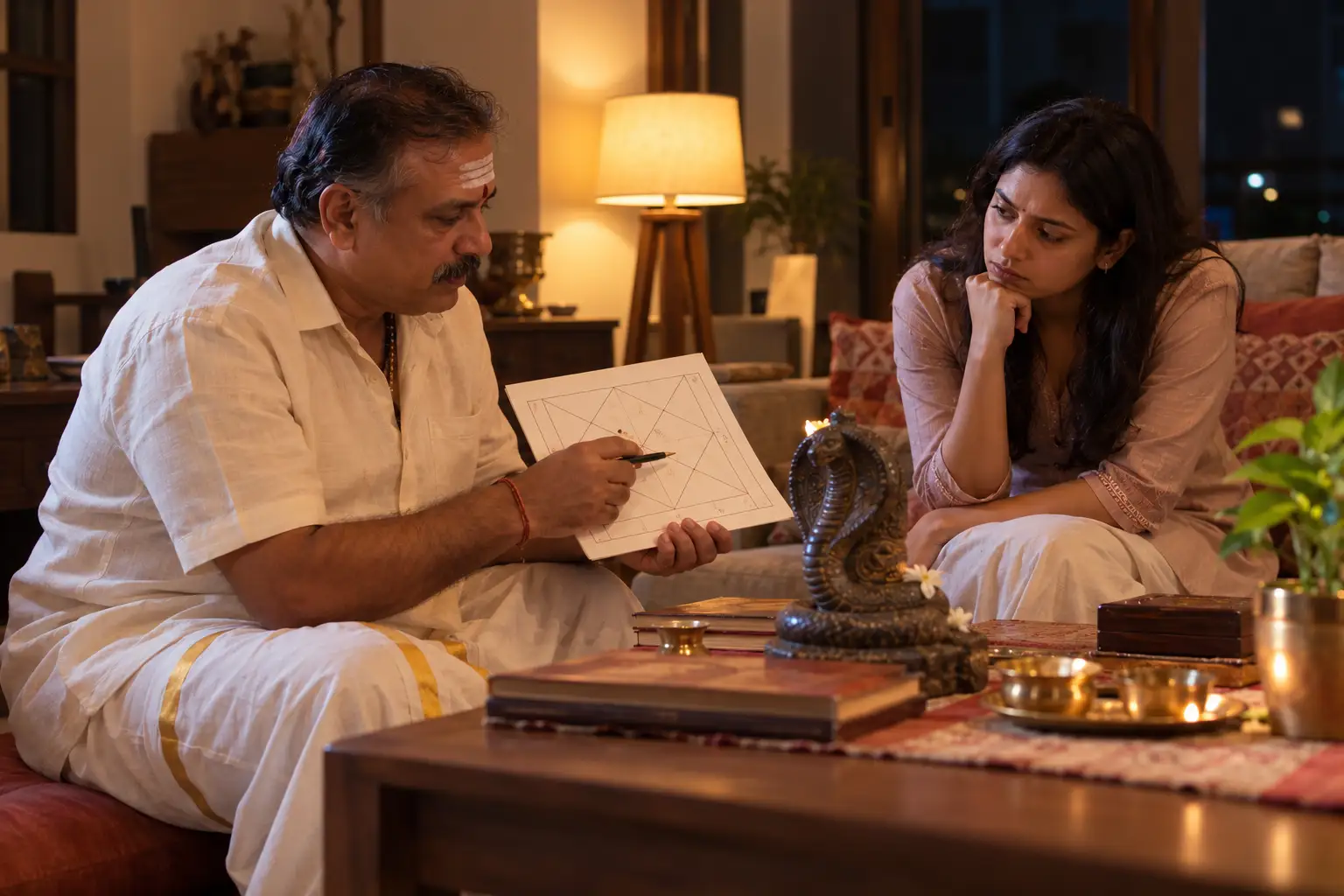
Rahu and Ketu always sit exactly opposite each other in a chart, forming an axis across it. Kaal Sarp Dosh is said to form when all seven of the other planets — Sun, Moon, Mars, Mercury, Jupiter, Venus and Saturn — fall on one side of that axis, hemmed between Rahu and Ketu.
The imagery behind the name is a serpent, with Rahu as the head and Ketu as the tail, and the remaining planets held within. In interpretation it is associated with a life pattern where things require more effort, results arrive later than expected, and progress feels obstructed in ways that are hard to attribute.
What it is not, and this needs saying at the outset: it is not a curse, it does not appear in the oldest classical texts as a named dosha, and it does not predict specific misfortune. It is a pattern in a chart. How much it matters depends entirely on the rest of that chart — which is precisely the part that gets skipped when a label is handed out and a ritual quoted in the same conversation.
Full, Partial, or Not at All
This is the single most useful distinction on the page, and the one most commonly ignored.
Full formation. All seven planets sit strictly between Rahu and Ketu. This is the actual dosha as described.
Partial formation. One or more planets fall outside the axis. The pattern is incomplete, and traditionally the effect is regarded as considerably reduced or absent. Yet partial formations are routinely presented to clients as full ones.
Borderline cases. Where a planet sits very close to Rahu or Ketu, whether it counts as inside or outside depends on the exact degrees. Different software handles this differently, which is one reason people receive contradictory verdicts.
Not present. Simply not the case, though a calculator using loose rules may still flag something.
The practical consequence is worth stating bluntly. Before any discussion of remedies, the first question is whether the formation is complete, and if a planet sits near the axis, at what degree. A consultation that cannot answer that precisely has not actually checked.

The Twelve Types
Where the formation is genuine, the type depends on which house Rahu occupies, and each carries a different area of emphasis. Knowing the type turns a vague label into something specific.

| Type | Rahu in House | Area Traditionally Emphasised |
|---|---|---|
| Anant | 1st | Self, temperament, personal effort |
| Kulik | 2nd | Family, wealth accumulation, speech |
| Vasuki | 3rd | Siblings, courage, initiative |
| Shankhpal | 4th | Home, mother, domestic peace |
| Padma | 5th | Education, children, creativity |
| Mahapadma | 6th | Health, competition, debts |
| Takshak | 7th | Marriage, partnership, dealings |
| Karkotak | 8th | Sudden change, inheritance, depth |
| Shankhachur | 9th | Fortune, father, higher learning |
| Ghatak | 10th | Career, standing, profession |
| Vishdhar | 11th | Gains, networks, fulfilment |
| Sheshnag | 12th | Expenditure, foreign, isolation |
Severity Depends on the Rest of the Chart
This is where responsible reading separates from label-and-sell, and it is straightforward once stated.
The same formation in two charts produces very different situations. Where the ascendant lord is strong, benefics are well placed, and the running Dasha is supportive, the pattern tends to show as a life requiring more effort rather than one that is blocked. Where the chart is otherwise weak and the Dasha demanding, the same formation coincides with a harder stretch — but so would a demanding Dasha without it.
The condition of Rahu and Ketu themselves matters too. Their sign, their dignity, and whether benefics aspect them all modify the picture substantially.
And timing matters more than most treatments admit. Many people with this formation report difficulty concentrated in particular years and relative ease in others — which follows the Dasha sequence rather than the formation, since the formation is constant and the difficulty is not. If the pattern were the whole explanation, the difficulty would not come and go.
Anyone attributing every difficulty in your life to this single formation is not reading your chart. They are reading a label.

Remedies — What Actually Helps and What Is Sold
This section is the reason the page exists, because Kaal Sarp generates more unnecessary spending than any other configuration in Indian astrology.
What costs nothing and is genuinely traditional: Rahu and Ketu beej mantras, chanted on their days. Nag Panchami observance. Feeding birds, particularly on Wednesdays. Offering water to a Shiva lingam. Chanting Om Namah Shivaya. Donating according to means. These are the everyday remedies the tradition actually rests on, and they are available to anyone.
What is optional and traditional: a Kaal Sarp puja, including at Trimbakeshwar which is the best-known location for it. This is a genuine practice with real standing. It is also frequently sold with urgency, at prices that bear no relation to what the ritual involves, to people whose formation was never verified.
What should raise a question: any quote presented urgently, any claim that the puja must be done immediately or something will happen, any package that expands as the date approaches, and any recommendation made before the formation was confirmed as complete.
The honest sequence is this. Verify the formation. Establish the type and the severity in context. Begin with the free practices, which are what most people genuinely need. Consider a puja if you want to, from an unpressured position, having established that it applies to you at all.

Why This Dosha Attracts So Much Selling
It is worth understanding the mechanics, because understanding them is itself a protection.
Three features make this configuration commercially attractive in a way others are not. It is visually dramatic — the serpent imagery and the sight of all planets hemmed on one side of a chart is striking to a layperson in a way that a technical placement is not. It is easy to flag — any software can detect it instantly, including loosely. And it explains everything — because the effect described is general obstruction, any difficulty in any area can be attributed to it, which makes it an unusually flexible sales instrument.
Add a specific named remedy at a specific famous location and you have a complete commercial proposition that requires very little astrological work to deliver.
None of this means the configuration is meaningless. It means the label alone tells you almost nothing, and the gap between the label and a proper reading is exactly where the selling happens. A verification that costs a fraction of a puja is the sensible first step, and anyone unwilling to do that step before quoting a price has told you something useful about their practice.

Living With the Pattern
For people whose formation is genuine and complete, the useful question is not how to remove it but how to work with it, and that gets very little attention.
The pattern is associated with delay and effort rather than denial. What people with it most often describe is that things take longer, require more persistence, and arrive later than for others doing similar work — and then frequently do arrive.
Practically, that suggests a few things. Build longer timelines into plans rather than treating slower progress as failure. Expect to need more persistence at the same task, and treat that as the shape of the thing rather than as evidence you are on the wrong path. Avoid shortcuts and schemes promising quick results, which this pattern is particularly poorly suited to. And pay attention to the Dasha sequence, since the easier stretches are real and worth using rather than allowing to pass.
The most common thing people with this formation report, once they stop treating it as a curse, is relief at having an explanation for a pattern they had been taking personally. That is a legitimate benefit of understanding it, and it requires no ritual at all.
Where This Sits in Classical Tradition
This deserves a straightforward treatment rather than being either dismissed or oversold, because both happen and neither is honest.
Kaal Sarp Dosh does not appear as a named dosha in the oldest foundational texts of Jyotish in the way that, say, planetary dignities or the Dasha system do. It is a later development in the tradition, elaborated substantially over the last century or so, and its prominence in popular practice today is out of proportion to its standing in the classical literature.
Two conclusions get drawn from that fact, and both overreach. One camp uses it to dismiss the configuration entirely as a modern invention with no basis. The other ignores the point completely and presents it as ancient scripture requiring urgent remedy.
The reasonable position sits between them. Astrological traditions have always developed, and later observations are not automatically invalid because they are later. What the historical position does justify is proportion: a configuration whose standing is more recent and more contested deserves correspondingly more caution before large sums are spent on it, and correspondingly less certainty in how it is described to a worried person.
If a practitioner tells you this is ancient scripture and must be remedied immediately, they are either unaware of the history or choosing not to mention it. Either way it tells you something about how much weight to give the rest of what they say.
Partial Kaal Sarp and the Degree Question
This technical point decides a great many cases, and almost nobody explains it to clients, so it belongs in full.
Rahu and Ketu occupy exact degrees, not whole houses. A planet is inside the axis or outside it depending on where it sits relative to those precise degrees — not on which house it happens to occupy.
That produces a category of case that is genuinely borderline. A planet sitting a degree or two beyond Rahu is outside the axis, and the formation is broken. The same planet a degree the other way is inside, and the formation holds. In chart terms the planet may appear to be in the same house either way, which is exactly why quick visual assessments and loose software get it wrong.
There is also the question of how to treat a planet sitting almost exactly on Rahu or Ketu. Different traditions and different software handle this differently, and there is no single universally accepted answer — which is a genuine ambiguity rather than a failing.
What this means practically: when someone tells you the formation is present, ask at what degrees Rahu and Ketu sit, and whether any planet is within a few degrees of either. If they cannot answer, the assessment was visual rather than calculated. And if a planet is borderline, you are entitled to be told that it is borderline rather than being given a confident verdict the data does not support.
A great many people paying for Kaal Sarp remedies have a chart where one planet sits just outside the axis. Establishing that costs a few minutes.
Common Mistakes People Make
Almost all of these come from acting on the label rather than on a reading.
Myths Worth Clearing Up
This configuration carries more commercially motivated misinformation than any other.
| Common Belief / Myth | Practical Reality |
|---|---|
| Kaal Sarp Dosh is a curse that ruins your life. | It is a chart pattern associated with effort and delay. It does not appear as a named dosha in the oldest classical texts, and severity depends entirely on the rest of the chart. |
| An expensive temple puja is mandatory. | It is a genuine traditional option, not a requirement. Mantras, Nag Panchami, feeding birds and Shiva observance cost nothing and are what most people actually need. |
| If a calculator flags it, you have it. | Partial formations and borderline degree cases are routinely flagged as full. Whether all seven planets are strictly inside the axis is the question that settles it. |
| It explains every problem in your life. | The formation is constant while difficulties come and go, which follows the Dasha sequence. Anyone attributing everything to it is reading a label, not a chart. |
| The puja must be done urgently or something will happen. | Urgency here is a sales technique. Nothing about this configuration requires acting within any particular timeframe. |
| Nothing can be done except the ritual. | Understanding the type, working with longer timelines, and using the supportive Dasha stretches are practical responses that require no ritual at all. |
How the Consultation Works
Sequenced so that verification precedes any discussion of cost.
- Share Your Birth Details
Exact date, time and place of birth. Degrees matter here, so an accurate time is important.
- Check Completeness Precisely
Whether all seven planets are strictly within the axis, with borderline cases checked by degree.
- Identify the Type
Which of the twelve, based on Rahu house position, and what that emphasises.
- Assess Severity in Context
Ascendant lord strength, benefic placement, condition of Rahu and Ketu, and the running Dasha.
- State the Position Plainly
Not present, partial, or full — with severity — so you can stop wondering.
- Free Remedies First
The no-cost traditional practices, which suit most situations, explained properly.
- Puja Discussed Without Pressure
If you want to consider one, it is discussed from an unpressured position, having established it applies.
Kaal Sarp Consultations Across Greater Noida, Delhi NCR and Worldwide
In-person consultations are easiest across Greater Noida, Noida, Ghaziabad and the wider Delhi NCR region. For clients elsewhere in India or abroad, video-call sessions work equally well, and this is a frequent request from people living overseas whose family in India is pressing them toward an expensive ritual. An independent verification, delivered calmly, usually settles that conversation. Sessions are conducted in Hindi or English.
Who This Is For, and Who Needs Something Else
It genuinely helps anyone carrying an unverified Kaal Sarp label, people quoted a large sum for a puja who want an independent opinion, those told this explains every difficulty in their life, anyone wanting to know which type applies and what it means, and people abroad under family pressure about a ritual.
Who needs something else: if a different dosha has been raised, Manglik and Pitra Dosh each have their own consultation. If your concern is a difficult period more broadly rather than this specific formation, Sade Sati guidance or a full Kundli reading fits better. And if you want a broad understanding of your chart rather than one configuration, the full Kundli reading is the right starting point.
Frequently Asked Questions
It forms when all seven planets — Sun, Moon, Mars, Mercury, Jupiter, Venus and Saturn — fall on one side of the Rahu-Ketu axis, hemmed between them. It is associated with a pattern of effort and delay rather than denial, and it is not a curse.
Then the formation is partial, and traditionally the effect is regarded as considerably reduced or absent. This distinction matters enormously and is the most commonly ignored point — partial formations are routinely presented to clients as full ones.
Only partly. Calculators frequently flag partial formations and handle borderline degree cases inconsistently, which is why people receive contradictory verdicts. The question that settles it is whether all seven planets are strictly inside the axis, and at what degrees.
Twelve, determined by which house Rahu occupies — Anant in the 1st through Sheshnag in the 12th. Each emphasises a different area of life, which turns a vague label into something specific and workable.
No. A Kaal Sarp puja, including at Trimbakeshwar, is a genuine traditional option but not a requirement. Mantras, Nag Panchami observance, feeding birds and Shiva worship cost nothing and are what most situations actually call for.
Treat the urgency itself as a signal. Nothing about this configuration requires acting within any particular timeframe. Get an independent verification first — it costs a fraction of the ritual and frequently makes it unnecessary.
No, and anyone saying so is reading a label rather than a chart. The formation is constant while difficulties come and go — that pattern follows the Dasha sequence, not the formation.
It depends far more on the rest of the chart than on the formation. A strong ascendant lord, well-placed benefics and a supportive Dasha produce a very different situation from a weak chart in a demanding period, even with the identical formation.
Rahu and Ketu beej mantras on their days, Nag Panchami observance, feeding birds particularly on Wednesdays, offering water to a Shiva lingam, chanting Om Namah Shivaya, and donation according to means. These are what the tradition genuinely rests on.
Three reasons: it is visually dramatic on a chart, software flags it instantly including loosely, and the general obstruction it describes can be used to explain any difficulty. Add a famous ritual location and you have a commercial proposition requiring little actual astrological work.
The planetary positions in a birth chart do not change. What remedies aim at is easing the experience of the pattern. Understanding the type, planning with longer timelines, and using supportive Dasha stretches are practical responses requiring no ritual at all.
Build longer timelines into plans rather than reading slower progress as failure, expect to need more persistence at the same task, avoid schemes promising quick results, and use the easier Dasha stretches rather than letting them pass.
Only where the type points there — Takshak, with Rahu in the seventh, emphasises marriage and partnership. Other types emphasise other areas entirely, which is why identifying the type matters rather than accepting a general label.
This is a common situation. An independent verification, delivered calmly and in writing, usually settles the conversation — particularly where it establishes the formation is partial or the severity mild. Get the check before agreeing to the ritual.
Yes, with full accuracy, since it depends entirely on birth details and the exact degrees of the planets. In-person consultations are easiest across Greater Noida and Delhi NCR, but nothing is lost in a video-call verification.
Ready to Talk This Through?
Whether you are buying a new property, renovating, or simply want a second, honest opinion — Kkomal provides accurate, no-demolition guidance tailored to your unique layout and situation, in person across Greater Noida & Delhi NCR, and online for the rest of India and abroad.
📞 +91 99531 11782 | ✉ kkomalvasisht@gmail.com
Birth Time Rectification — When You Do Not Know Your Exact Time Business Astrology — Partnership, Timing and Knowing When to Push Career Astrology Consultation — Direction, Timing & Honest Guidance Education Astrology — Stream, Exams and Study Abroad Kaal Sarp Dosha Kundli / Birth Chart Vimshottari Dasha